
Media Coverage
Recent
-
- Viewpoint: Europe’s AI problem is not merely competition, but control, Science|Business, 23 Jul 2026
- Viewpoint: the EU’s ‘CERN for AI’ is nothing of the sort, Science|Business, 29 Jan 2026
- Polo de investigação em IA criado em Guimarães por rede europeia, ComUM, 23 October 2025
- Cidade de Guimarães acolhe polo de investigação europeia na área da Inteligência Artificial, Diario do Minho, 22 October 2025
- Rede de investigação europeia em IA cria polo em Guimarães, SAPO, 22 October 2025
- Trump’s $500B AI plan is ‘slap’ in the face for Europe, Politico, 22 January 2025
- Stargate: What is Trump’s new $500bn AI project?, Al Jazeera, 22 January 2025
- European AI ecosystem worried about new US export restrictions, Science|Business, 16 Jan 2025
- We have brought AI systems into the world without the risks being well understood, Telepolis, 27 June, 2024
- EU science advisers back call for a ‘CERN for AI’ to aid research, Science|Business, 15 Apr 2024
- Viewpoint: How Europe can show leadership for AI in science, Science|Business, 09 May 2024
Highlights
Viewpoint: Europe’s AI problem is not merely competition, but control
We do not own the leading-edge AI technology we rely on for research and innovation. We rent it, mostly from US companies
Science|Business, 23 July 2026
(…) Europe’s dependence on foreign-controlled AI has consequences for knowledge production, technological development, economic competitiveness and national security. Access can be withdrawn, restricted or used as geopolitical leverage. (…)
(…) The authors call for European-controlled computing and data infrastructure, frontier AI models that European institutions can scrutinise and adapt, and an independent organisation with the ambition and durability of CERN or the European Space Agency. (…)
(…) “Europe can continue to rent the AI frontier. Or it can build enough of it to remain free.” (…)
Viewpoint: the EU’s ‘CERN for AI’ is nothing of the sort
The European Commission is playing with words. Its initiatives fall far short of what is needed
Science|Business, 29 January 2026
(…) CERN succeeded because European countries established an independent institution through an international treaty, providing it with political legitimacy, scientific autonomy and stable long-term funding. (…)
(…) The authors argue that AI factories and short-term research programmes do not share the characteristics that made CERN successful. Applying the CERN label to these initiatives risks diluting the concept without creating the institution Europe needs. (…)
(…) “The CERN model is more than historical inspiration: it provides a proven blueprint for ambitious scientific collaboration.” (…)
(…) Europe needs “a CERN for AI worthy of the name.” (…)
Trump’s $500B AI plan is ‘slap’ in the face for Europe
The scale of the US Stargate initiative exposes the widening gap between American and European investment in artificial intelligence
Politico, 22 January 2025
(…) The $500 billion Stargate announcement demonstrated the scale at which the United States is prepared to invest in AI infrastructure, while Europe continues to divide its resources across smaller national and EU initiatives. (…)
(…) Holger Hoos, Chair of the Board of CAIRNE, described the announcement as a “‘slap’ in the face” for Europe and a warning that its current level of ambition is insufficient. (…)
(…) Without comparable infrastructure, investment and coordination, Europe risks becoming increasingly dependent on AI technologies developed and controlled in the United States. (…)
Stargate: What is Trump’s new $500bn AI project?
AI giants join forces for a massive project aimed at growing technology in the United States
Al Jazeera, 22 January 2025
(…) The concentration of frontier AI capabilities in a small number of US companies creates risks extending well beyond the technology sector, according to Holger Hoos, Chair of the Board of CAIRNE. (…)
(…) Other countries could lose technological sovereignty, while industries that increasingly depend on advanced AI systems would face a growing competitive disadvantage. US control of these technologies could also provide Washington with political leverage through export controls and sanctions. (…)
(…) “The risk is when cutting-edge AI technology is controlled by few companies all headquartered in the US,” Hoos said. (…)
European AI ecosystem worried about new US export restrictions
European researchers warn that restrictions on advanced AI chips could divide the EU and damage its technological competitiveness
Science|Business, 16 January 2025
(…) The decision to impose restrictions on some EU countries while exempting others caused concern across Europe’s AI community. Holger Hoos warned that treating EU member states differently undermines European unity and exposes the continent’s technological dependence. (…)
(…) The restrictions could affect not only AI research but also industries such as aviation and automotive manufacturing, which increasingly rely on advanced AI technologies and access to state-of-the-art chips. (…)
(…) “This divisive approach by the US is undermining the very idea underlying the European Union,” Hoos said. (…)
EU science advisers back call for a ‘CERN for AI’ to aid research
Expert panel wants the European Commission to give academics more computing power and data to lead AI innovations
Science|Business, 15 April 2024
(…) The European Commission’s chief scientific advisers recommended establishing a state-of-the-art European facility providing researchers with computing power, cloud infrastructure, high-quality data, talent and training. (…)
(…) Holger Hoos welcomed the growing political support for a “CERN for AI”, an idea advanced by CAIRNE since 2018. However, he warned that the proposed institute focused too narrowly on the use of AI in science and lacked the wider ambition required to support European industry, engineering and public administration. (…)
(…) “I believe any moonshot effort needs a visible focal point,” Hoos said. (…)
“Wir hören zu häufig bei Prototypen auf”
CLAIRE and ELLIS receive the German AI Innovation Prize
WELT, 4 October 2021
(…) The 2021 German AI Innovation Prize was awarded jointly to CLAIRE, now CAIRNE, and ELLIS for their contributions to artificial intelligence research and development in Europe. (…)
(…) The jury recognised the two cross-border research networks for seeking to strengthen Europe’s position in global competition with the United States and China. The initiatives bring together researchers and institutions from across the continent and support the development of European AI based on shared values. (…)
(…) The €100,000 award is one of the most highly endowed prizes of its kind in Europe. (…)
Scientists split as Europe paves way for ‘Cern of AI’
Brussels wants to create centre hosting ‘the best talents in the field’, but some researchers doubt that a single organisation can tackle all the challenges
Times Higher Education, 25 February 2020
(…) The European Commission’s proposal for a world-leading AI research centre was described as a step towards the vision promoted by CLAIRE, now CAIRNE. The network had been calling on European policymakers to support an AI research hub modelled on CERN. (…)
(…) CLAIRE proposed combining a central institute with a Europe-wide network. Leading researchers would spend part of their time at the hub, working with dedicated computing facilities while retaining their positions at institutions across Europe. (…)
(…) “‘Critical mass’ is the word that we really like,” said Holger Hoos. “You really have to integrate all of Europe.” (…)
Warning over brain drain of European AI talent to industry
Figures in Elsevier report on AI research landscape are ‘a call to action’
Times Higher Education, 11 December 2018
(…) “European countries need to urgently improve conditions for researchers working in artificial intelligence to stem a brain drain of talent moving from academia to industry, sector leaders have said.” (…)
(…) “Holger Hoos, professor of machine learning at Leiden University, said that he was “deeply concerned” by the brain drain of researchers from European universities, which he said was “progressing at an alarming rate”.
He has co-launched an initiative called CLAIRE, which already has the support of around 1,400 AI experts. It aims to strengthen pan-European cooperation on AI and hopes to establish a central state-of-the-art AI hub similar in scale to the Cern physics lab in Switzerland.
“We need a massive pan-European effort to coordinate and support excellence in AI research and innovation – an effort that generously supports the very best talent in the field and that matches expertise between academia and industry,” Professor Hoos said.” (…)
UK and EU AI communities will only be globally significant if they work as one
The European Union and the UK will be left behind in artificial intelligence research and development if they take separate paths after Brexit
Computer Weekly, 22 January 2020
(…) Asked whether the UK AI community will play a role in the organisation after Brexit, [Holger] Hoos said: “You bet, at least if we have anything to say about it.” (…)
(…) “[Hoos said:] “We made it very clear that no matter what happens with Brexit and the relationship between the EU and the UK, in AI we should work together.”
The EU and the UK will have to work closely together if they are to have any significance in global AI developments, said Hoos. The US and China are the biggest players, but there is an opportunity for another region to set a new path, he added. “China and the US are very different to each other and different to Europe in how AI is seen going forward.” (…)
“We want to help ensure that Europe can play a leading role in AI research and innovation,” [Hoos] said. “We believe, as many do, that AI is a very important set of technologies going forward, not only for economic prosperity, but for the benefit of society. We therefore think it is very important that Europe as a geographic region is doing the right thing with AI in order to remain competitive and do the right thing for European citizens.”
How Europe can improve the development of AI
Its real clout comes from its power to set standard
The Economist, 20 September 2018
(…) “To be successful in the global push for AI, Europe needs to stand united; weakly coordinated national AI initiatives are insufficient to compete globally.” (…)
(…) “to become a powerhouse in AI, Europe will have to overcome its divisions, digital and otherwise” (…)
See also CLAIRE’s brief memorandum, “Memo on Artificial Intelligence (AI) in Europe: Funding and Positioning“, created after the prominent coverage on AI in Europe in the Economist.
This memo is intended for decision makers at the national and EU levels, and addresses the 5 main points of the Economist articles “Can the EU become another AI superpower?” and “How Europe can improve the development of AI”:
To be successful in the global push for AI, Europe needs to stand united; weakly coordinated national AI initiatives are insufficient to compete globally.
Over 2,000 European AI experts join hands to challenge US, China in artificial intelligence
More than 2,000 researchers join forces to urge EU to help continent build ‘Google-style’ infrastructure as counterweight to the two leading AI players
South China Morning Post, 21 September 2018
(…) “[Philipp Slusallek] said one of the main goals of [CLAIRE] was to nurture AI talent and retain it in Europe. This could be accomplished by setting up dedicated AI research and development centres throughout the continent, which would provide “Google-scale” infrastructure such as computing power and data centres, he said.” (…)
(…) “In recent years some major exponents of the field such as Yann LeCun, founder of Facebook’s AI Research lab, and Google Brain’s Geoffrey Hinton were born and educated in European countries but moved to North America to continue their work.” (…)
(…) “Europe spent about US$4 billion on AI research in 2016 while China spent US$7 billion, according to a report by McKinsey Global Institute last year. But this was dwarfed by the figure for North America which was estimated to be about US$23 billion.” (…)
Coverage of CLAIRE Launch (June 2018)
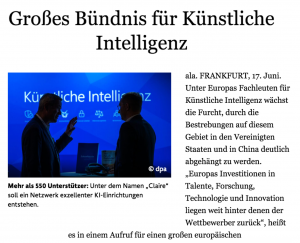
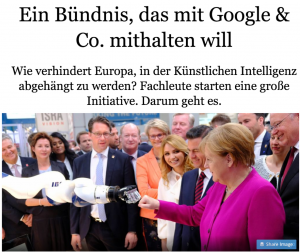
Frankfurter Allgemeine Zeitung, 18 June 2018 – Front page article.
One of the most prominent and widely read daily newspapers in Germany.
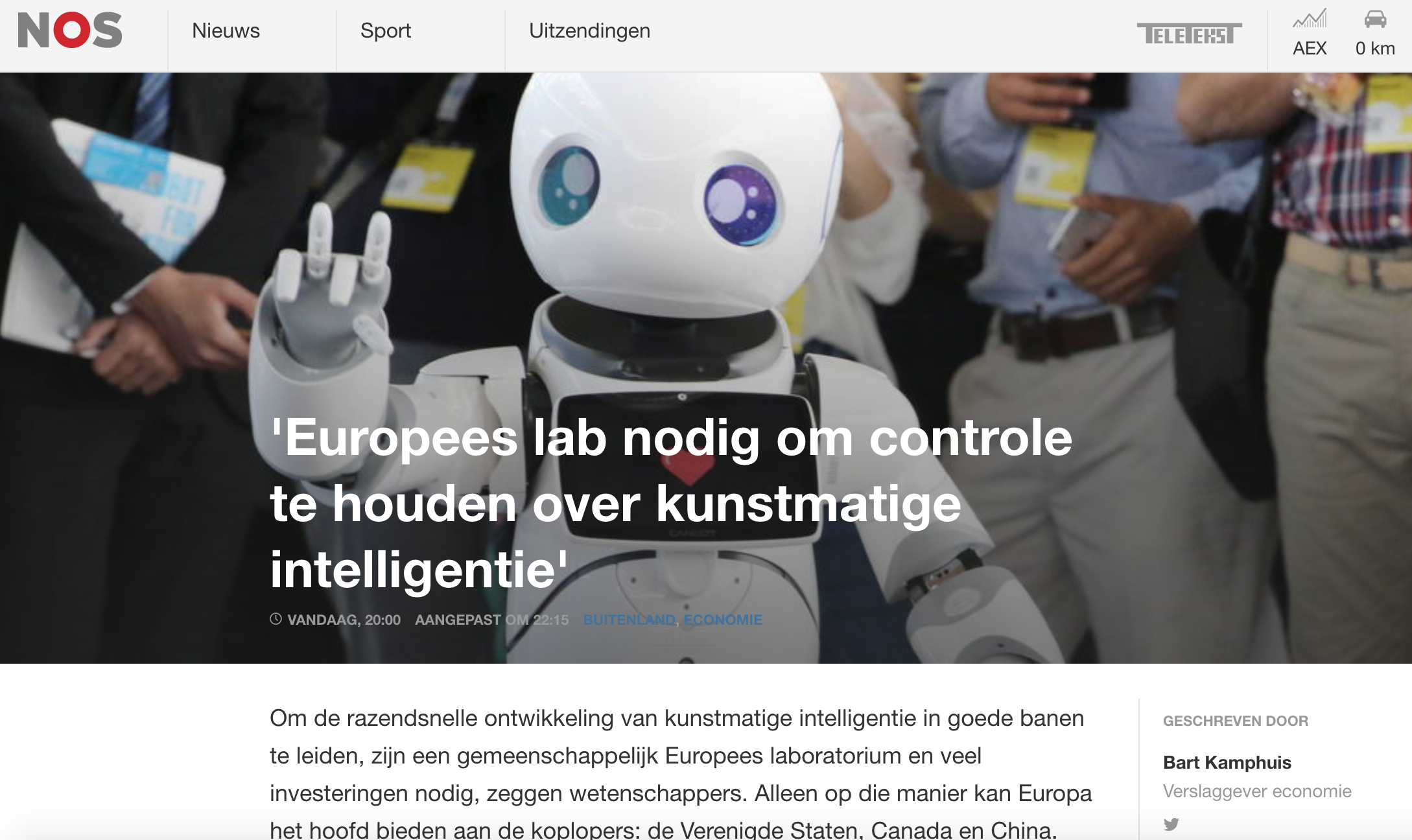
The NOS 20:00 Evening News and corresponding article, 18 June 2018.
NOS is one of the main public TV stations in the Netherlands.
The article starts at 4:50, in Dutch, but Holger Hoos is interviewed in English from 5:45.
Archive
General:
- Viewpoint: the EU’s ‘CERN for AI’ is nothing of the sort, Science|Business, 29 Jan 2026
- Trump’s $500B AI plan is ‘slap’ in the face for Europe, Politico, 22 January 2025
- Stargate: What is Trump’s new $500bn AI project?, Al Jazeera, 22 January 2025
- European AI ecosystem worried about new US export restrictions, Science Business, 16 Jan 2025
- We have brought AI systems into the world without the risks being well understood, Telepolis, 27 June, 2024
- EU science advisers back call for a ‘CERN for AI’ to aid research, Science Business, 15 Apr 2024
- Viewpoint: How Europe can show leadership for AI in science, Science Business, 09 May 2024
- Call for the EU to build publicly funded cutting-edge artificial intelligence, Science Business, 04 Jan 2024
- “Viewpoint: Europe needs a CERN for artificial intelligence”, Science Buisness, 24 October 2023
- “Germany promises huge boost in artificial intelligence research funding and European coordination”, Science Business, 31 August 2023
- “CLAIRE wins prestigious Artificial Intelligence prize”, Mirage News, 07 October 2021
- “CLAIRE and ELLIS Won Innovation Award by The German AI Prize”, AI on Demand, 07 October 2021
- “CLAIRE and ELLIS receive German AI Prize 2021”, AIHub, 04 October 2021
- “Trust in EU approach to artificial intelligence risks being undermined by new AI rules”, Science |Business, 02 Sep 2021
- “CLAIRE endorses EU plan for AI and makes 10 key recommendations”, AIHub, 19 June 2020
- “European researchers look beyond deep learning”, E&T, 28 January 2020
- “Europe’s largest initiative for excellence in human-centred artificial intelligence opens its headquarters in The Hague, the Netherlands”, Global Travel Media, 11 December 2019
- “Europe’s largest initiative for excellence in human-centered Artificial Intelligence opens its headquarters in the Hague”, Connect World, 11 December 2019
- “Europe’s largest initiative for excellence in human-centred artificial intelligence opens its headquarters in The Hague”, Kongres Magazine, 10 December 2019
- “The Hague a CLAIRE winner as headquarters of ‘AI for Good’”, AMI Magazine, 11 December 2019
- “Headquarters of world’s largest AI research network CLAIRE is now open in The Hague”, Silicon Canals, 10 December 2019
- “Europe’s next €1-billion science projects: six teams make it to final round”, Nature, 11 February 2019
- “Assessing Artificial Intelligence for Humanity”, IEEE Technology and Society Magazine, 01 February 2019
- “It’s Time Europe Had its Own AI Centre”, AI Hub Europe (date unknown)
- “CLAIRE: A European Vision for Artificial Intelligence”, AI Hub Europe (date unknown)
Australia:
Belgium:
- “600 AI-onderzoekers vragen Europa om in actie te schieten”, DataNews (in Dutch), 19 June 2018
- “600 chercheurs en AI demandent à l’Europe de passer à l’action”, DataNews (in French), 19 June 2018
- “Roep voor Europees AI-instituut zwelt aan”, De Tijd, 18 June 2018
- “Waarom AI-wetenschappers aan de alarmbel trekken”, VRT NWS, 18 June 2018
China:
Czech Republic:
- “Jak přežít konverzaci o umělé inteligenci? Pomůže vám “brAInfood””, Bulletin of National Centre for Industry 4.0, 23 June 2021
- “PŘEDNÍ EVROPSKÁ ORGANIZACE PRO UMĚLOU INTELIGENCI CLAIRE SLAVÍ DVA ROKY OD SVÉHO VZNIKU. JEJÍ PRAŽSKOU KANCELÁŘ HOSTÍ A VEDE CIIRC ČVUT”, Czech Technical University in Prague, 22 June 2020
- “The Czech Republic and Czech Institute of Informatics, Robotics, and Cybernetics CTU to Play Major Role in Europe’s AI Research”, CIIRC, 9 March 2020
France:
Germany:
- “„AI made in Europe“ am Wendepunkt”, Tagesspiegel Background, 07 July 2023
- “CLAIRE und „euRobotics” vertiefen Zusammenarbeit”, Tagesspiegel, 18 March 2022
- „Wir hören zu häufig bei Prototypen auf“, 04 October 2021
- Forschungsnetzwerke ELLIS und CLAIRE bekommen KI-Preis 2021, 01 October 2021
- “WELT zeichnet mit dem Deutschen KI-Preis 2021 herausragende Leistungen zu Künstlicher Intelligenz aus Innovationspreis mit 100.000 Euro für die europäischen KI-Forschungsnetzwerke ELLIS und CLAIRE”, 01 October 2021
- Forschungsnetzwerke ELLIS und CLAIRE bekommen KI-Preis 2021
- “CLAIRE MIT DEM „DEUTSCHEN KI-PREIS“ AUSGEZEICHNET”, 30 September 2021
- “KI Made in Europe”, Behoerden Spiegel, 18 March 2020
- “EU Commission: 50 million start-up funding for the AI alliance Claire”, Heise, 17 March 2020
- “CLAIRE erhält breites Mandat und Finanzierung für die Gestaltung von “KI made in Europe”, IDW, 16 March 2020
- “Die Plätze am KI-Fördertopf sind verteilt”, Tagesspiegel16 March 2020
- “Europa: Der Digitalplan steht”, Tagesspiegel, 20 February 2020
- “Brauchen Exzellenz in der ganzen Bandbreite der KI”, Tagesspiegel, 11 February 2020
- “KI-Forschung: Miteinander statt gegeneinander?”, Tagesspiegel, 11 February 2020
- “Europe’s largest initiative for excellence in human-centred artificial intelligence opens its headquarters in The Hague, the Netherlands”, Convention International, 10 December 2019
- “Künstliche Intelligenz: Europa hat enormen Nachholbedarf “, CANCOM, 22 February 2019
- “Ein europäisches CERN für die Künstliche Intelligenz”, Luxemburger Wort, 03 January 2019
- “Maschinen nach menschlichem Vorbild”, Luxemburger Wort, 31 August 2018
- “CLAIRE soll die Erforschung der künstlichen Intelligenz in Europa fördern“, University of Münster, 21 June 2018
- “Ein CERN für Künstliche Intelligenz?”, Physik Journal, 20 June 2018
- “600 Experten für Künstliche Intelligenz unterzeichnen Aufruf für europäische Initiative”, German Research Centre for Artificial Intelligence, 18 June 2018
- “Europäisches KI-Bündnis: 600 Experten fordern größere Anstrengungen”, Heise, 18 June 2018
- “Neues Forschungsbündnis soll künstliche Intelligenz in Europa voranbringen”, Handelsblatt, 18 June 2018
- “Europäische KI-Experten gründen das Bündnis Claire.”, Turi2, 17 June 2018:
Hungary:
Italy:
- “Intelligenza Artificiale: alla scoperta di Claire”, algoritmoumano.it, 24 May 2021
- “Intelligenza artificiale, il piano europeo piace alla rete di esperti”, 01net, 21 February 2020
- “CLAIRE approva il piano della Commissione per un’Europa digitale”, BitMAT, 21 February 2020
- “Intelligenza artificiale, progetto CLAIRE arriva a Roma: riunirà oltre 250 gruppi di ricerca in Europa”, Blitz Quotidiano, 21 March 2019
- “Taranto, la Regione si candida per il «Cern dell’intelligenza artificiale»,” La Gazzetta del Mezzogiorno, 28 January 2019
- “Intelligenza artificiale, ecco Claire il laboratório che si ispira al Cern. Il papà della robótica: “Serbatoio di eccellenze””, Il Fatto Quotidiano, 23 January 2019
- “Appello per un Cern dell’intelligenza artificiale in Europa”, Agenzia Nazionale Stampa Associata, 02 July 2018
- “Claire, il “Cern” europeo dell’Intelligenza Artificiale che proverà a sfidare Usa e Cina”, Start Magazine, 21 June 2018
The Netherlands:
- “CLAIRE opens four new offices and celebrates with roadshows”, Leiden University, 19 May 2021
- “CLAIRE: Connector in the AI landscape”, NL AIC, 15 April 2021
- “Major win for CLAIRE in 50 million euro round of “seed funding””, Leiden University, 26 March 2020
- “Nederland, pak die kans met kunstmatige intelligentie”, de Volkskrant, 24 February 2020
- “Lack of funding leaves Dutch AI lagging”, Bits&Chips, 20 February, 2020
- “World’s Largest AI Research Network CLAIRE Opens Headquarters in The Hague”, Netherlands Foreign Investment Agency (NFIA), 16 December 2019
- “European AI research network Claire opens HQ in The Hague”, Bits&Chips, 16 December 2019
- “AI research network Claire opens headquarters in the Hague”, Telecompaper, 12 December 2019
- “Major steps towards realising a bold vision for European Excellence in AI”, Leiden University, 15 March 2019
- “Waarom we onze kaarten op kunstmatige intelligentie moeten zetten”, VNO-NCW, February 2019
- “The problem for AI in Europe is not the money it is finding talent”, Medium, 11 September 2018
- “Nederland kampt met braindrain in artificiële intelligentie”, NRC Handelsblad, 27 August 2018
- “Topwetenschappers: ‘Europa moet investeren in onderwijs en onderzoek rond AI'”, Dutch IT-channel, 19 June 2018
- “Europees lab nodig om controle te houden over kunstmatige intelligentie”, NOS, 18 June 2018
- “Europa verliest de slag op gebied van kunstmatige intelligentie”, Leiden University, 18 June 2018
- “Kunstmatige intelligentie: Europa dreigt slag om de toekomst te verliezen “, NPO Radio 1, 18 June 2018
- “Talent kunstmatige intelligentie ontvlucht Europa”, AG Connect, 18 June 2018
Norway:
- “CLAIRE offers help in the Coronavirus crisis”, NORA, 27 March 2020
- “CLAIRE – the World’s largest Network for AI Research”, NORA 20 December 2019
- “600 eksperter i kunstig intelligens signerer opprop om europeisk handling”, ITBaktuelt, 20 June 2018
- “OsloMet vil ha Norge med i kunstig intelligens-utviklingen”, Khrono, 19 June 2018
Portugal:
- Polo de investigação em IA criado em Guimarães por rede europeia, ComUM, 23 October 2025
- Cidade de Guimarães acolhe polo de investigação europeia na área da Inteligência Artificial, Diario do Minho, 22 October 2025
- Rede de investigação europeia em IA cria polo em Guimarães, SAPO, 22 October 2025
Spain:
- “La falta de coordinación deja a Europa a la cola de la carrera por la IA”, MIT Technology Review, 26 November 2018
- “Un millar de expertos piden a la Unión Europea más fondos para I+D en Inteligencia Artificial”, MuyComputerPRO, 21 June 2018
- “Un millar expertos piden mas recursos para I+D en inteligencia artificial UE”, La Vanguardia, 20 June 2018
- “Un millar expertos piden mas recursos para I+D en inteligencia artificial UE”, EFE Futuro, 20 June 2018
- “Europa no puede quedarse atrás en inteligencia artificial”, El País, 19 June 2018
- “600 expertos europeos reclaman un proyecto común para la inteligencia artificial”, Computerworld, 19 June 2018
Sweden:
United Kingdom:
- “Scientists split as Europe paves way for ‘Cern of AI’”, Times Higher Education, 25 February 2020
- “UK and EU AI communities will only be globally significant if they work as one”, Computer Weekly, 22 January 2020
- “European AI labs link up to exploit synergies”, DataIQ, 18 December 2019
- “Human-centred AI initiative opens its headquarters”, Electronics Specifier, 11 December 2019
- “Europe’s largest initiative for excellence in human-centered artificial intelligence opens its headquarters in The Hague”, TechRound, 11 December 2019
- “World’s largest AI research network opens in The Hague”, National Technology, 10 December 2019
- “Europe ‘losing ground’ to US and China on AI research”, Times Higher Education, 9 May 2019
- “How Europe can improve the development of AI”, The Economist, 20 September 2018